Ed Bradon
Who should get a paid AI license in your organisation?
How to improve ROI without increasing spend

Free, paid and pro LLM tiers differ wildly in price and capability, and allocating them fairly and effectively at scale is difficult. Common approaches — like first come first serve and use it or lose it — have big downsides. A better way is possible.
Working out who should get what sort of LLM license is a new and high-stakes challenge for organisations trying to adopt AI. Particularly difficult is deciding between the free tiers of ChatGPT, Copilot or Claude, paid tiers that might cost $20-40 per month a month, and pro tiers that can run upwards of $200. With 100s or 1,000s of users costs add up fast, and while for some staff a paid license is a nice-to-have, for others it can unlock transformative productivity. Getting this right can be the difference between an AI rollout that succeeds and one that stalls.
Lots of the obvious solutions have big downsides. ‘First come first serve’ and ‘use it or lose it’ models are straightforward but risk leaving behind any staff who are coming to AI more slowly. Many of these later-adopters would be the among the biggest beneficiaries from AI: just think of the acceleration for a non-technical employee suddenly learning how to steer a superhuman coder-analyst in plain English. Assigning licenses to management-designated ‘super users’ suffers from a similar problem: guesses about who will get the most out of AI are often plain wrong. At Pair time and again we see many managers (pleasantly!) surprised at who in their teams achieve AI mastery first.
We think it’s possible to do better, and we’ve been working hard to turn these LLM license provisioning decisions into something that happens fairly and organically. We think everyone should have the chance to access the most advanced LLM features available within their organisation, especially if they’ve proved their competence to use them. At the same time, there’s no point paying for a premium license for a user who hasn’t got to those advanced features yet.
So this is what we’ve built into the admin dashboard on the Pair platform: a ‘license allocation helper’. Pair certification has become a very strong predictor – and driver – of advanced LLM use: users who achieve Mastery are ~15× more likely to use advanced features than those who aren’t certified.
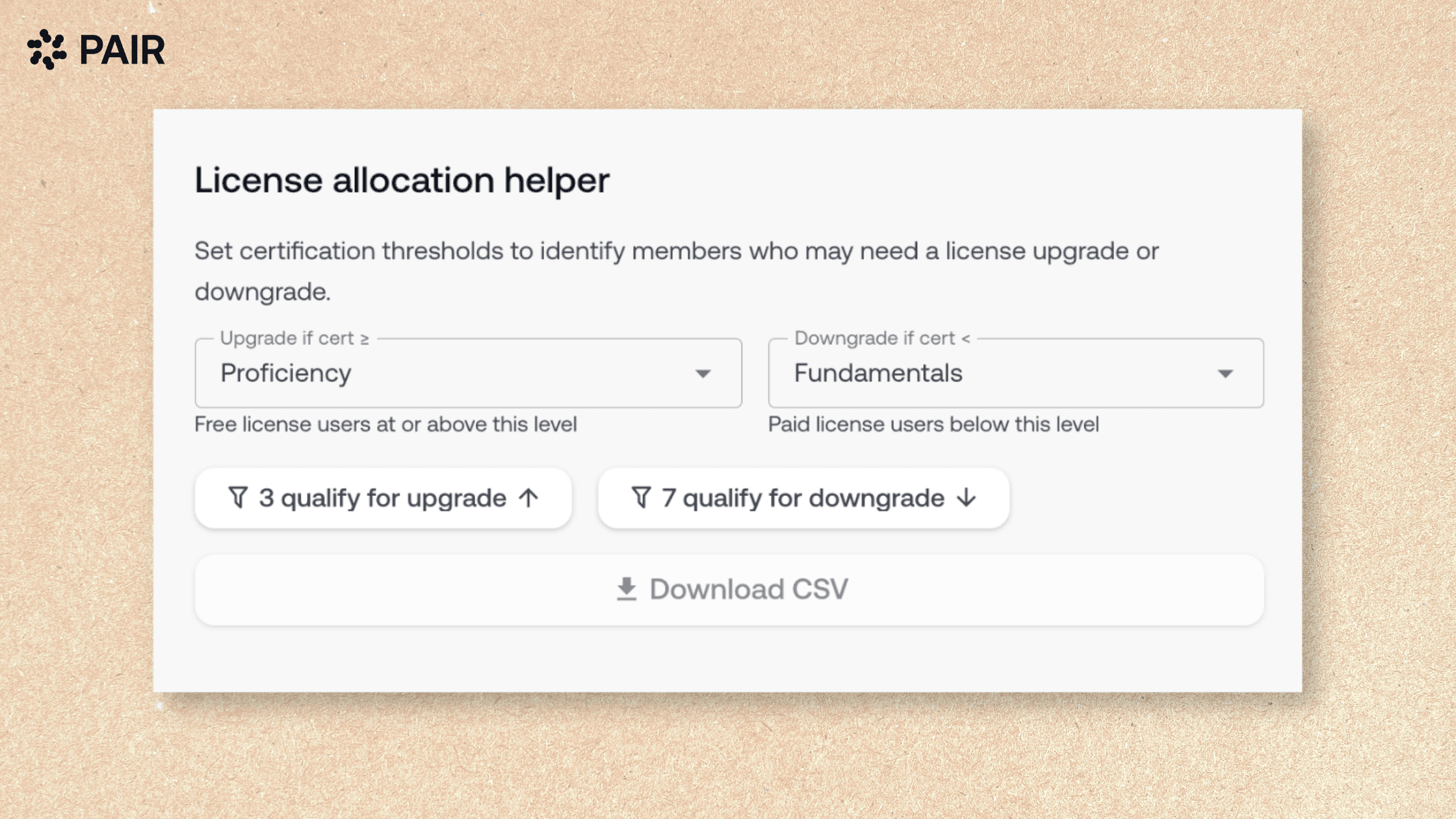
Pictured: the Pair license allocation helper. The upgrade and downgrade suggestions are based on your criteria and can be exported directly to CSV.
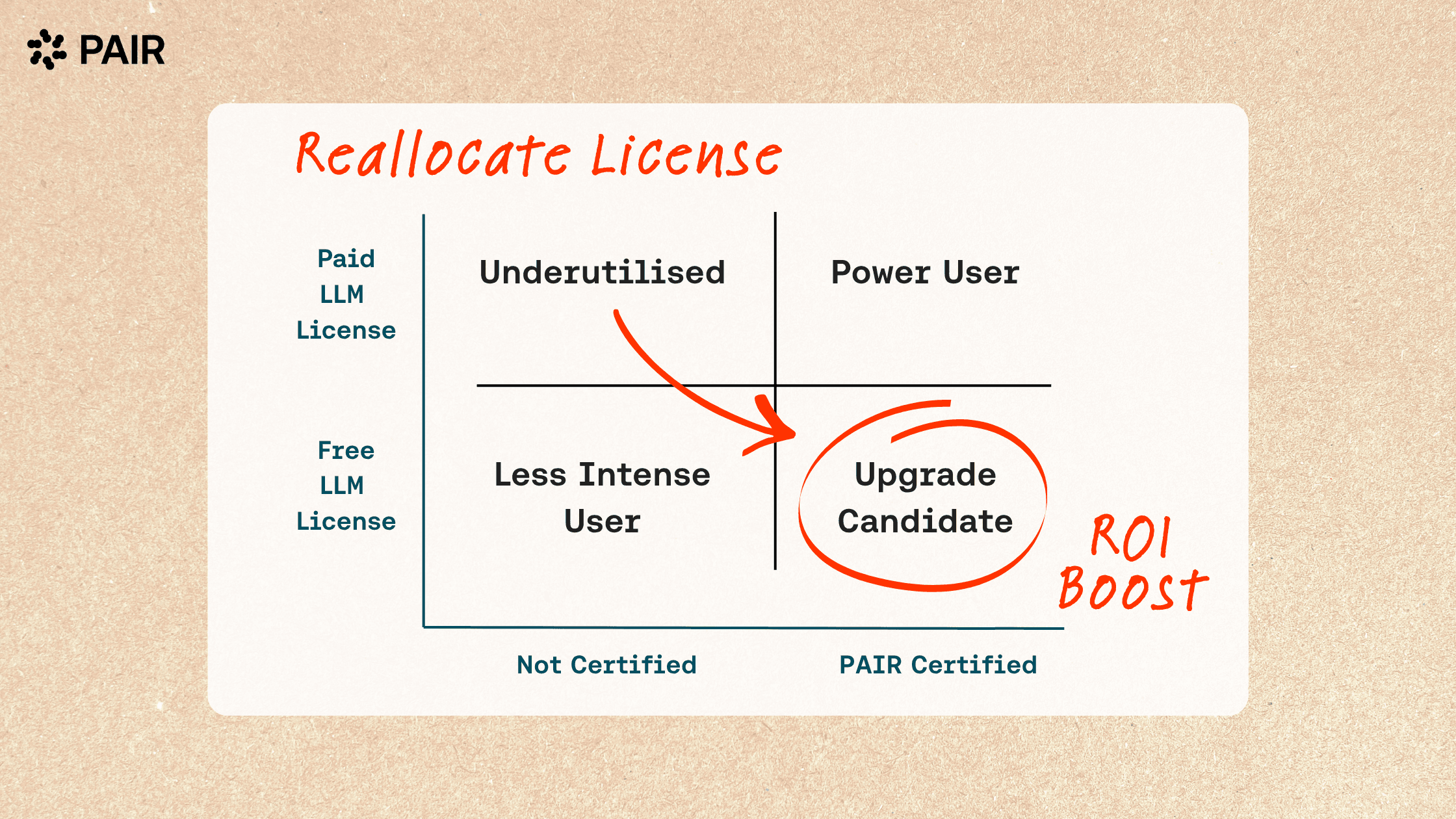
The license allocation helper takes advantage of this, first by letting Pair admins see who has a free-tier license today, and then out of this group who has proven their AI capability by progressing furthest through the hands-on AI Masterclasses. Users above a capability threshold (and organisations can pick the level that makes sense to them) are then automatically identified for an upgrade.
Conversely, users with premium licenses who aren’t yet ready to make the most of LLM’s more advanced capabilities can be flagged to move back to the free tier. Unlike ‘use it or lose it’, which can bring a novice user’s AI journey to an end with a bump, this isn’t a one-way street. All they need to do is work through the masterclasses and when they’re ready, they can be upgraded back to the paid tier.
We hope that balancing these two groups can increase your ROI from the licenses you’re paying for, without increasing spend, in a way that’s fair, easy to explain and easy to administer:
Ed Bradon
Ed Bradon
Who should get a paid AI license in your organisation?
How to improve ROI without increasing spend
Free, paid and pro LLM tiers differ wildly in price and capability, and allocating them fairly and effectively at scale is difficult. Common approaches — like first come first serve and use it or lose it — have big downsides. A better way is possible.
Working out who should get what sort of LLM license is a new and high-stakes challenge for organisations trying to adopt AI. Particularly difficult is deciding between the free tiers of ChatGPT, Copilot or Claude, paid tiers that might cost $20-40 per month a month, and pro tiers that can run upwards of $200. With 100s or 1,000s of users costs add up fast, and while for some staff a paid license is a nice-to-have, for others it can unlock transformative productivity. Getting this right can be the difference between an AI rollout that succeeds and one that stalls.
Lots of the obvious solutions have big downsides. ‘First come first serve’ and ‘use it or lose it’ models are straightforward but risk leaving behind any staff who are coming to AI more slowly. Many of these later-adopters would be the among the biggest beneficiaries from AI: just think of the acceleration for a non-technical employee suddenly learning how to steer a superhuman coder-analyst in plain English. Assigning licenses to management-designated ‘super users’ suffers from a similar problem: guesses about who will get the most out of AI are often plain wrong. At Pair time and again we see many managers (pleasantly!) surprised at who in their teams achieve AI mastery first.
We think it’s possible to do better, and we’ve been working hard to turn these LLM license provisioning decisions into something that happens fairly and organically. We think everyone should have the chance to access the most advanced LLM features available within their organisation, especially if they’ve proved their competence to use them. At the same time, there’s no point paying for a premium license for a user who hasn’t got to those advanced features yet.
So this is what we’ve built into the admin dashboard on the Pair platform: a ‘license allocation helper’. Pair certification has become a very strong predictor – and driver – of advanced LLM use: users who achieve Mastery are ~15× more likely to use advanced features than those who aren’t certified.
Pictured: the Pair license allocation helper. The upgrade and downgrade suggestions are based on your criteria and can be exported directly to CSV.
The license allocation helper takes advantage of this, first by letting Pair admins see who has a free-tier license today, and then out of this group who has proven their AI capability by progressing furthest through the hands-on AI Masterclasses. Users above a capability threshold (and organisations can pick the level that makes sense to them) are then automatically identified for an upgrade.
Conversely, users with premium licenses who aren’t yet ready to make the most of LLM’s more advanced capabilities can be flagged to move back to the free tier. Unlike ‘use it or lose it’, which can bring a novice user’s AI journey to an end with a bump, this isn’t a one-way street. All they need to do is work through the masterclasses and when they’re ready, they can be upgraded back to the paid tier.
We hope that balancing these two groups can increase your ROI from the licenses you’re paying for, without increasing spend, in a way that’s fair, easy to explain and easy to administer:
Ed Bradon
Ed Bradon
Who should get a paid AI license in your organisation?
How to improve ROI without increasing spend
Free, paid and pro LLM tiers differ wildly in price and capability, and allocating them fairly and effectively at scale is difficult. Common approaches — like first come first serve and use it or lose it — have big downsides. A better way is possible.
Working out who should get what sort of LLM license is a new and high-stakes challenge for organisations trying to adopt AI. Particularly difficult is deciding between the free tiers of ChatGPT, Copilot or Claude, paid tiers that might cost $20-40 per month a month, and pro tiers that can run upwards of $200. With 100s or 1,000s of users costs add up fast, and while for some staff a paid license is a nice-to-have, for others it can unlock transformative productivity. Getting this right can be the difference between an AI rollout that succeeds and one that stalls.
Lots of the obvious solutions have big downsides. ‘First come first serve’ and ‘use it or lose it’ models are straightforward but risk leaving behind any staff who are coming to AI more slowly. Many of these later-adopters would be the among the biggest beneficiaries from AI: just think of the acceleration for a non-technical employee suddenly learning how to steer a superhuman coder-analyst in plain English. Assigning licenses to management-designated ‘super users’ suffers from a similar problem: guesses about who will get the most out of AI are often plain wrong. At Pair time and again we see many managers (pleasantly!) surprised at who in their teams achieve AI mastery first.
We think it’s possible to do better, and we’ve been working hard to turn these LLM license provisioning decisions into something that happens fairly and organically. We think everyone should have the chance to access the most advanced LLM features available within their organisation, especially if they’ve proved their competence to use them. At the same time, there’s no point paying for a premium license for a user who hasn’t got to those advanced features yet.
So this is what we’ve built into the admin dashboard on the Pair platform: a ‘license allocation helper’. Pair certification has become a very strong predictor – and driver – of advanced LLM use: users who achieve Mastery are ~15× more likely to use advanced features than those who aren’t certified.
Pictured: the Pair license allocation helper. The upgrade and downgrade suggestions are based on your criteria and can be exported directly to CSV.
The license allocation helper takes advantage of this, first by letting Pair admins see who has a free-tier license today, and then out of this group who has proven their AI capability by progressing furthest through the hands-on AI Masterclasses. Users above a capability threshold (and organisations can pick the level that makes sense to them) are then automatically identified for an upgrade.
Conversely, users with premium licenses who aren’t yet ready to make the most of LLM’s more advanced capabilities can be flagged to move back to the free tier. Unlike ‘use it or lose it’, which can bring a novice user’s AI journey to an end with a bump, this isn’t a one-way street. All they need to do is work through the masterclasses and when they’re ready, they can be upgraded back to the paid tier.
We hope that balancing these two groups can increase your ROI from the licenses you’re paying for, without increasing spend, in a way that’s fair, easy to explain and easy to administer:
Ed Bradon